Flex TPO: Your market Compass for smarter trading decisions
Flex TPO combines Initial Balance and TPO/Market Profile to give you crystal-clear references on when to trade and where to act.

Without structure, every trade is a guess
You see the breakout but hesitate
Price breaks a high, escapes a range, or cuts through a trendline – it looks like a clean breakout on the chart.But in that moment, you're stuck.
Entering immediately feels like chasing.You've been stopped out enough times to hesitate.Waiting for a pullback offers no clear reference – no level to trust, no structure to guide you.You either jump in late out of FOMO or stay on the sidelines and miss a good move.


Initial Balance & TPO — not tradable
Initial Balance and TPO are concepts you’ve read about and understand in theory.But on a live chart, they remain abstract.Initial Balance feels like just an opening time window, not a tradable reference.TPO shows market structure but doesn’t tell you where to act, wait, or what to do next.
Overtrading in unclear conditions
You take trades while price is stuck in a range – up and down, back and forth.The moves seem tradable, but they lack follow-through.Stops get hit, not because of bad entries, but because the market never fully committed.So you keep trading through the noise, adjusting levels, tweaking setups, and trying again.By the end of the session, you’ve overtraded with little to show for it.
What sets Flex TPO apart
Most breakout indicators stop at one question: “Did price break?”Flex TPO is built around a deeper one: “What does the market do after it breaks?”To answer that, the indicator combines 2 established concepts – Initial Balance and TPO / Market Profile – into a single, rule-based process focused on post-breakout behavior.For this approach to work, Initial Balance cannot be treated as a once-per-day reference.Instead of waiting for a new session, Flex TPO defines Initial Balance continuously, cycle by cycle, as the market evolves.In each cycle, the market:
Forms its own balance
Tests direction
Either commits or returns to balance
This reflects how markets actually behave: they rebalance repeatedly, not just once per day.
How Flex TPO tracks Breakout & Retest behavior


1 - Segment the market

Flex TPO divides the market into time-based segments, each one forming a mini trading cycle with its own structure.The segment duration is user-defined – for example, 15, 30, or 45 minutes – ensuring consistent structure across trading styles and timeframes.
2 - Form Initial Balance

Within each segment, the indicator does NOT search for signals right away.It starts by defining Initial Balance – the price range the market establishes while finding early equilibrium.
3 - Build mini TPO & POC

Instead of treating Initial Balance as a static High–Low box, Flex TPO adds context.It builds a mini TPO profile inside the Initial Balance, and identifies the POC – the price level where the market spent the most time
4 - Wait for Breakouts

The indicator does NOT react to every touch of the Initial Balance range.It waits for a confirmed breakout – a candle close outside the range – before generating a Break signal.
5 - Find Retests after the Breakout

After a confirmed break, the indicator continues to track price behavior.It uses the POC as a reference for potential Retests, helping assess whether the market is truly holding direction.
Initial Balance – Defined by Time or Volume
Initial Balance is the core reference in Flex TPO. Inside the range, the market is balancing. Outside the range, direction becomes actionable. This creates a clear, rule-based framework: No breakout → no rush to trade.Flex TPO identifies the Initial Balance zone using 2 distinct modes:
Mode 1: Continuous

In this mode, Initial Balance is defined by the High–Low range of the first N bars of the session.It is designed for traders who prefer a simple, session-based structure.Why it works:
Fixed-time structure creates consistent, comparable market context
Single logic across timeframes without distortion
Clear balance boundaries help reduce overtrading
Mode 2: Volume Trigger

In this mode, Initial Balance is formed only when volume confirms participation.The indicator:
Groups N consecutive bars into a volume block
Compares that block with prior N blocks in the segment
Triggers Initial Balance when the current block has the highest volume
Draws the balance zone from that block’s High–Low
This mode filters out low-activity periods and focuses on higher-quality market conditions. It is suitable for traders who prefer selective, high-quality setups.
TPO / Market Profile & POC
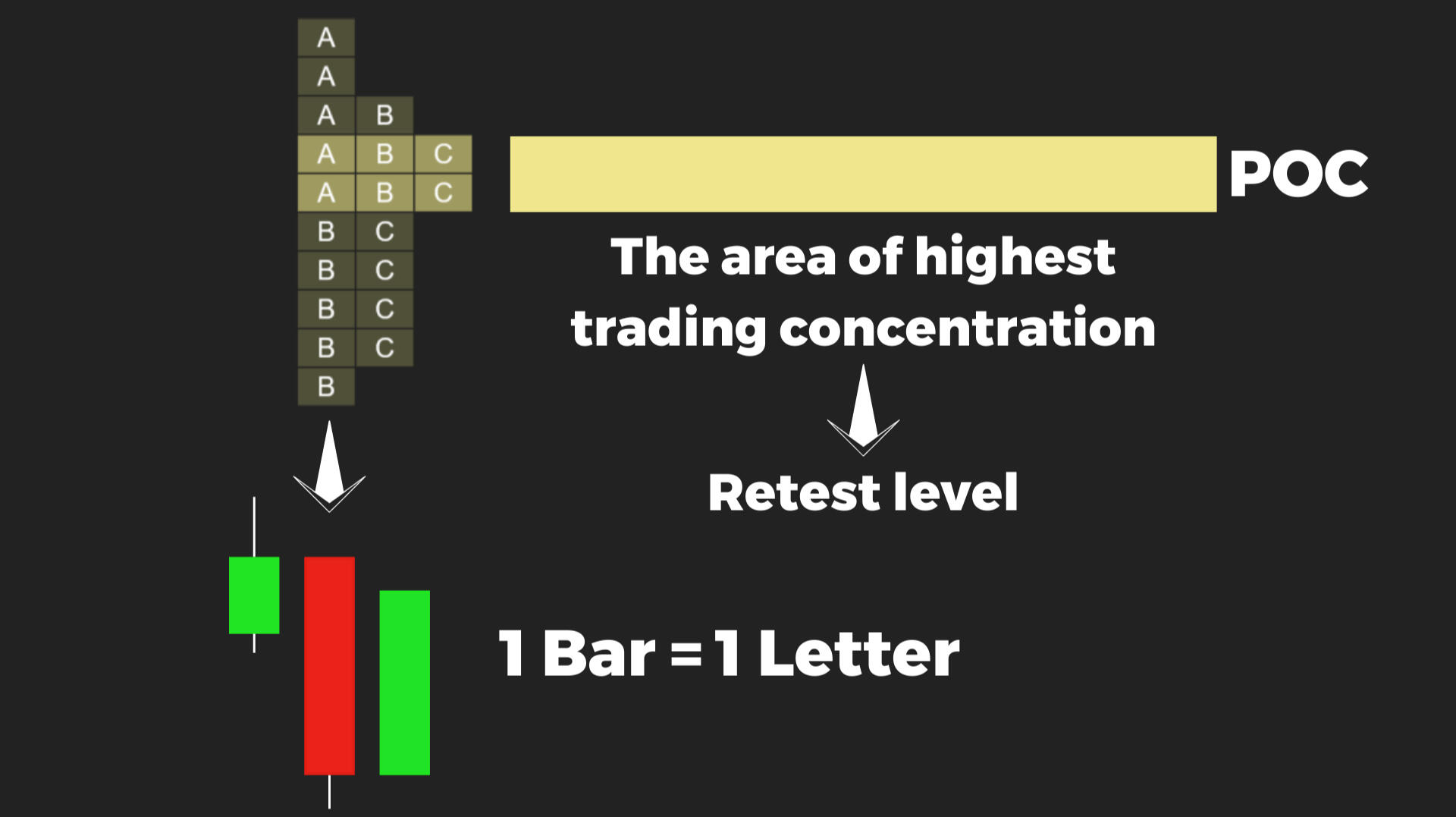
TPO / Market Profile answers a critical question: “Which price level did the market accept the most?”Flex TPO builds a mini TPO profile inside the Initial Balance to extract one key level: the POC (Point of Control).The POC acts as:
The center of balance
The level price is most likely to retest after a break
The reference point for evaluating breakout quality
By anchoring decisions to the POC, Flex TPO turns Initial Balance from a simple range into a value-based, behavior-driven reference:
Price returns to the POC and is rejected → Breakout strength remains intact
Price cuts through the POC easily → Breakout is weak and prone to failure
Break & Retest – Actionable trade signals


Flex TPO does not react to every price expansion. It separates Breakout & Retest into 2 distinct, rule-based signals.By separating Structure (Initial Balance) → Confirmation (Breakout) → Behavior (Retest at POC), the indicator turns breakout trading from a reaction into a process.
Break signal
Triggered only when a candle closes outside the Initial Balance.
Confirms the transition from balance to directional intent.
Filters noise and significantly reduces false breakouts
Retest signal
Triggered when price returns to the POC after a confirmed break.
Provides a structured re-entry, allowing participation without chasing price
Retest-based entries typically offer better location and tighter risk control than entries taken at the break
Flex TPO in Real-Time Market Conditions
In this video, Mr. James showcases a live trading session using Flex TPO with Captain Optimus Strong automation. Instead of chasing breakouts, he places LMT orders and waits for price to retest the breakout level before entering.
This video shows how Flex TPO provides a structured framework for trading breakouts and retests with more clarity and less emotional decision-making.
In this video, Mr. James trades live to demonstrate how Flex TPO identifies key zones and tracks reliable breakouts.
This video demo shows how Flex TPO uses the Initial Balance to identify more reliable breakouts.
Let’s take a look at the newly released Flex TPO video for a clear, complete overview.
This video shows why timing and key levels matter more than direction, and how Flex TPO helps traders avoid FOMO and enter at the right time and level.
Read genuine feedback from our traders:


Check out the 30-day backtest results of Flex TPO on GC 1-min chart:


Watch the backtest results of Flex TPO on NQ 1-min chart for 30 days:


If you are having some questions, let us answer them all...
Enjoy special price during the new release phase
Core power option
Total value: $1040, including:
(1) license of Flex TPO: $700 value
Personalized support: $100 value
1-year product update: $140 value
Trader's manual & templates: $100 value
Now only
$396
Enhanced strategy option
Total value: $1620, including:
(1) license of Flex TPO: $700 value
(1) license of Zerolag Schaff Trend Cycle: $400 value
Personalized support: $100 value
1-year product update: $220 value
Trader's manual & templates: $200 value
Now only
$496
Auto strategy option
Total value: $2920, including:
(1) license of Flex TPO: $700 value
(1) license of Infinity Algo Engine$: $2,700 value
Personalized support: $100 value
1-year product update: $680 value
Trader's manual & templates: $200 value
Now only
$1056
Your purchase is fully covered with our 45-day ninZaExchange policy
Use the complete indicators in live market conditions for 45 days.
Run them on your preferred platform, your markets, and your trading approach.If you don’t experience a clear improvement in market clarity, timing, or risk-to-reward awareness, we’ll exchange it for any other indicator with little to no additional cost.

Your Market Compass Awaits, Take Control with Flex TPO